Community, service, academics, leadership, and interfaith community are at the foundation of Saint Louis University’s Micah program.
Micah: Living the Mission
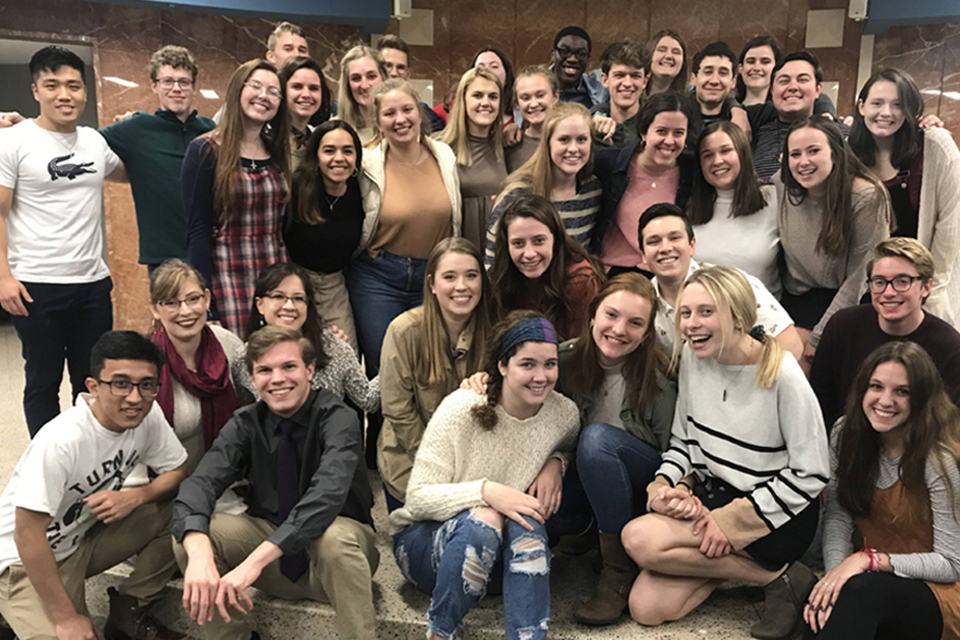
The Micah Program is a distinctive service and social justice-based program whose legacy began in 1997 as SLU’s first learning-based, themed-housing opportunity for students. After more than 25 years, the Micah Program has grown into a thriving community of students actively engaged in positive social change through service in the St. Louis community. The Micah Program seeks to support the University’s mission of “for and with others” by focusing on pillars of service, academics, community, interfaith and leadership. Micah provides special sections of interdisciplinary courses that aim to develop students’ understanding of social justice issues and to provide opportunities for guided reflection on their experiences.
Micah integrates themes of social justice and service and is named after the Biblical prophet Micah, who spoke out against social inequities in ancient Israel. The program welcomes students from all faiths, religious and non-religious beliefs, all backgrounds, and all areas of study to live together in community.
The primary aim of the program is to support the University's mission of "for and with others" by:
- Establishing a community of students united through a collective commitment to social justice and shared experiences of service, community building, and reflection. These students serve, study and live together as a learning community on campus.
- Deepening students’ ability to think critically about social justice issues that affect our local and global communities through special sections of interdisciplinary courses that fulfill core requirements for most majors.
- Deepening students' understanding of such issues by facilitating their community service centered on building relationships and providing guided reflection on their experiences.
- Empowering students to be champions of their own “faith in action” by providing extensive leadership opportunities within Micah and encouraging involvement in other social justice organizations.
- Supporting the students' ongoing community through SLU graduation and beyond.
Act Justly. Love Mercy. Walk humbly.
Micah 6:8
Program Requirements
As a first-year Micah, you must meet the following requirements:
- Serve the St. Louis community for at least 30 hours per semester at an approved Micah service site. This is an average of two to three hours per week.
- Take at least three Micah-section courses, two in the fall and one in the spring, which also fulfill the University’s core requirements.
- Meet as a community for one hour every Monday evening from 7-8 p.m.
- Attend a one-day retreat in the fall and a weekend retreat in the spring.
"The people in the Micah service-based learning community have challenged me and pushed me to grow. I am forever grateful for open conversations, weekly service, late-night talks and tangents, and, most importantly, the wonderful friendships."
Claire Creedon, class of 2021
Apply
About 200 students, ranging from first-years to seniors, are actively involved in SLU’s Micah program. They come from all over the world and study in dozens of majors.
Up to 50 first-year students are admitted to the Micah program each year. Students interested in the first-year community must submit a brief online application during their senior year of high school. Applications are accepted beginning Dec. 1. Early applications are encouraged.
You can apply to the Micah program through your SLU admission portal. Once in the portal, login by clicking "Undergraduate" (top button if you have not applied to SLU, bottom button if you have already submitted your SLU application) and continue to the Micah application. If you have any problems or questions, please email us at micah@slu.edu.